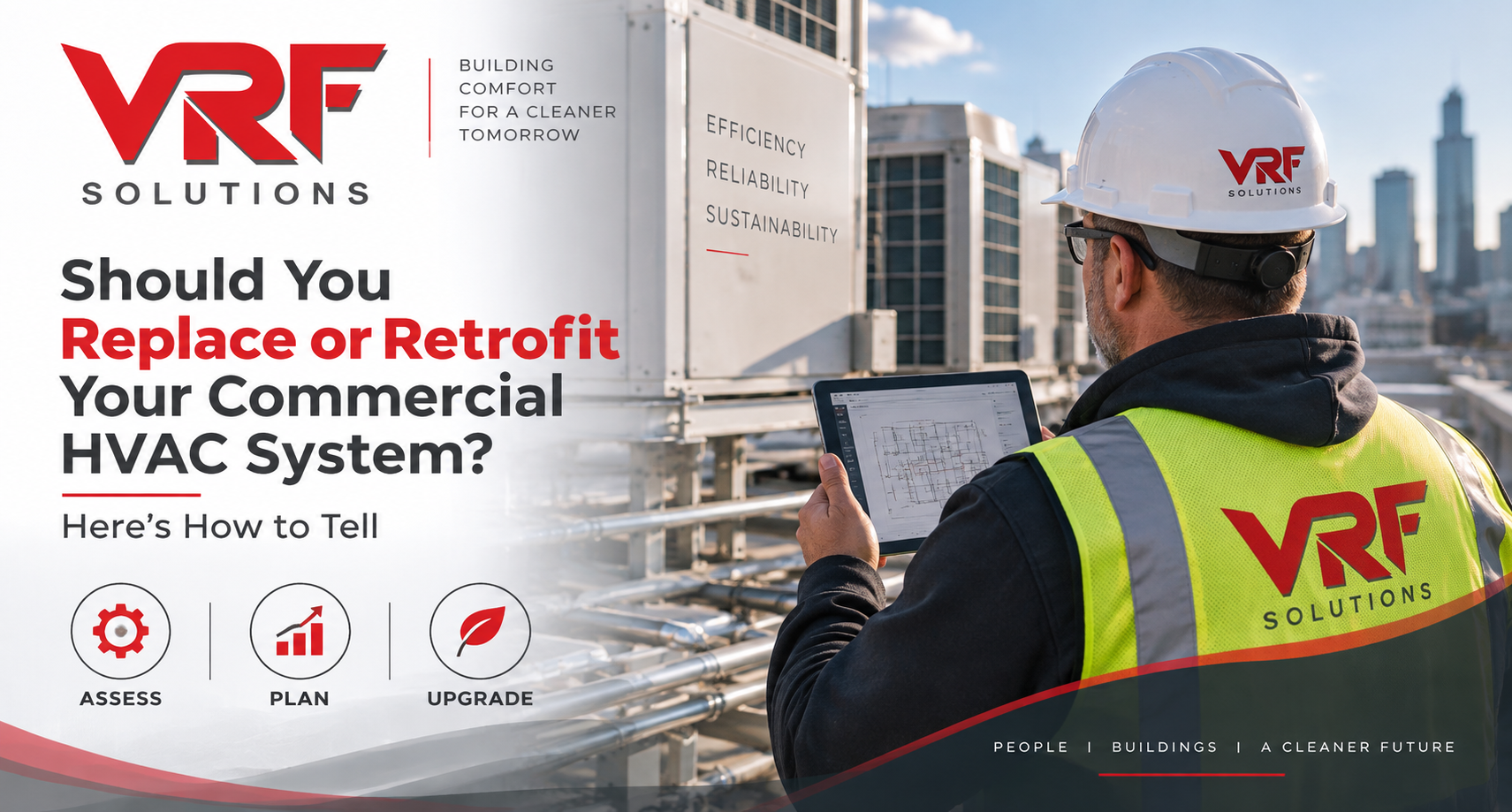
Should You Replace or Retrofit Your Commercial HVAC System?
Heating and cooling can have a major impact on the comfort, energy use, and day-to-day operation of a commercial building. As HVAC equipment gets older, building owners and facility managers often face an important question: Should we replace the entire HVAC system, or can we retrofit the existing system?
There is no single answer that works for every property. The right choice depends on the condition of the equipment, the building’s needs, energy goals, available infrastructure, and long-term plans. Understanding the difference between replacement and retrofitting can help you make a more informed decision.
What Does an HVAC Retrofit Mean?
Retrofitting means improving or modifying an existing HVAC system rather than removing everything and starting over. Depending on the building, a retrofit might involve upgrading controls, replacing selected equipment, improving zoning, adding heat pumps, or integrating newer technology with parts of the existing system.
A retrofit can be useful when significant parts of the current infrastructure are still in suitable condition. The goal is generally to improve comfort, efficiency, control, or performance without necessarily replacing the complete system.
Companies such as VRF Solutions work with commercial and multifamily properties on HVAC, heat-pump, electrification, and mechanical projects, where understanding the building’s existing conditions is an important part of planning an upgrade.
What Does a Full HVAC Replacement Involve?
A replacement is a larger project. Instead of improving individual components, the existing heating and cooling equipment may be removed and replaced with a new system designed around the building’s current requirements.
Replacement may make sense when equipment is reaching the end of its useful service life, repairs are becoming frequent, or the existing system no longer supports the property’s comfort and efficiency goals.
It can also provide an opportunity to reconsider how the entire building is heated and cooled instead of simply replacing old equipment with similar technology.
1. Consider the Age and Condition of Your Equipment
Age alone should not determine whether a system needs replacement, but it is an important factor.
Older equipment may require more frequent repairs, have outdated controls, or perform less efficiently than newer alternatives. On the other hand, a well-maintained system may still contain components that can remain useful as part of a carefully designed retrofit.
A professional assessment can help identify which equipment is performing properly and which components may be creating problems.
2. Look at Your Energy Consumption
Increasing utility costs do not automatically mean your HVAC equipment needs to be replaced. However, unexplained changes in energy consumption deserve attention.
Dirty components, control problems, poor zoning, aging equipment, air leakage, insulation issues, or incorrect system operation can all contribute to unnecessary energy use.
Before investing in major changes, it is useful to understand where the energy is actually being used. This makes it easier to determine whether targeted improvements or a broader system replacement would offer greater value.
3. Pay Attention to Comfort Problems
Do employees or tenants regularly complain that one part of the building is too hot while another is too cold?
Uneven temperatures can indicate problems with zoning, system design, controls, equipment performance, or the way a building’s use has changed over time.
Modern VRF systems can provide individual zoning and heating and cooling flexibility for different areas. Property owners considering this technology may benefit from consulting a Best commercial VRF heat pump contractor in Stamford, CT to understand whether VRF is appropriate for the building rather than assuming it is automatically the best option.
4. Think About How the Building Has Changed
Commercial buildings rarely remain exactly as they were when their HVAC systems were originally installed.
Office layouts change. Businesses expand. Rooms are divided. Occupancy levels increase or decrease. A retail space might become an office, or an older property may undergo extensive renovation.
When the building changes but the HVAC system does not, performance problems can develop. In these situations, a retrofit may help the system adapt. For major changes, however, redesigning or replacing the system could make more sense.
5. Consider Your Electrification Goals
Many commercial property owners are exploring ways to reduce reliance on fossil-fuel heating and move toward electric heat-pump technology.
This does not always mean every existing component must immediately be removed. Some buildings can transition through planned upgrades, while others may benefit from a more comprehensive conversion.
The electrical capacity, building envelope, heating and cooling loads, available space, equipment configuration, and local requirements should all be considered before deciding on an electrification strategy.
6. Compare Short-Term Cost With Long-Term Value
A retrofit may require a smaller initial investment than complete replacement, but upfront price should not be the only consideration.
Think about future repairs, maintenance requirements, energy consumption, equipment reliability, tenant comfort, and how long you plan to own or operate the building.
Spending less today is not necessarily economical if major equipment will need replacement shortly afterward. At the same time, replacing equipment that still performs effectively may not always provide enough benefit to justify the investment.
7. Get the Building Evaluated Before Deciding
Commercial HVAC systems can involve heating, cooling, ventilation, controls, electrical infrastructure, piping, and other interconnected components. That makes a professional building assessment particularly valuable.
For example, working with a mechanical contractor near Greenwich Village NY can help property owners evaluate existing mechanical conditions, project requirements, system options, and potential challenges before construction begins.
Final Thoughts
Choosing between retrofitting and replacing a commercial HVAC system should start with understanding the building—not choosing equipment.
If the existing infrastructure remains suitable, targeted upgrades may improve performance without requiring a complete replacement. If the equipment is aging, unreliable, inefficient, or poorly suited to current building needs, a new system may offer greater long-term value.
The most effective decision comes from evaluating equipment condition, energy use, comfort, building changes, future goals, and overall project costs together. A well-planned HVAC strategy can help create a more comfortable, reliable, and efficient commercial building for years to come.